How to Start a Business in Alberta (2026)
This page is the free Alberta guide. No sign-in. Read on, or take the checklist as a PDF.
Facts checked October 2026 · See what changed · How we check
Registration, tax accounts, and structure comparison: everything you need to get your Alberta business set up legally.
Alberta business setup guide
1
Business Structures in Alberta
Open this section ↓↑ Close this sectionSole Proprietorship
Registration: Register trade name with Alberta Corporate Registry via authorized agent if not operating under legal nameLiability: Unlimited personal liabilityTax: Personal incomeBest for: Low-risk, simple operationsPartnership
Registration: Register partnership name via registry agentLiability: Unlimited personal liabilityTax: Pass-through to partnersBest for: Small professional practicesAlberta Corporation
Registration: Articles of Incorporation via Alberta Corporate Registry (through authorized agent)Liability: Limited liabilityTax: Alberta general corporate rate 8% / small-business rate 2%; federal general 15% / small-business 9%. A typical small incorporated business qualifies for the small-business rates (AB 2% + federal 9%). No provincial sales taxBest for: Growth businesses; Alberta has no PST which simplifies complianceFederal Corporation
Registration: Incorporate federally; register provinciallyLiability: Limited liabilityTax: Corporate tax; must register in AlbertaBest for: Multi-province businesses2
Registration Details: Alberta
Open this section ↓↑ Close this sectionProvincial Registry
Alberta Corporate Registry (via authorized registry agents only)
Official registry →Sole Proprietorship / Trade Name
Registration required for trade names: See current fee at registry →
Alberta requires registration of any trade name. All filings go through private authorized registry agents. There is no government self-serve portal. Fees are set by the agent.
Register here →Provincial Corporation
Filing fee: See current fee at registry →
Alberta has no provincial sales tax, simplifying compliance. Corporations must file an annual return with Alberta Corporate Registry through an authorized agent.
Incorporate provincially →Federal Corporation (optional)
Filing fee: $200
Federal corporations can operate nationwide but must also register in each province where they carry on business. The incorporation document is Form 1: Articles of Incorporation (CBCA), filed with Corporations Canada (ISED) together with the Initial Registered Office Address and the Notice of Directors.
Incorporate federally (Corporations Canada / ISED) →3
Tax Registration in Alberta
Open this section ↓↑ Close this sectionCRA Business Number (BN)
Register with CRA for Business Number (BN). The registry-agent transaction typically triggers CRA BN issuance.
If registering by paper rather than online, use Form RC1 (Request for a Business Number and Certain Program Accounts); available at canada.ca.
GST / HST / QST
Alberta has no provincial sales tax. GST (5%) applies; register when revenues exceed $30,000.
Payroll
Register payroll account with CRA when hiring employees.
4
Business Name Search and Reservation
Open this section ↓↑ Close this sectionSystem: NUANS (national system, required for incorporations, private providers)Alberta incorporation requires a NUANS name search. There is no government self-serve portal. Registration is done through private authorized registry agents who set their own service fees.
5
Provincial Sales Tax in Alberta
Open this section ↓↑ Close this sectionType: None (no provincial sales tax)Alberta has no provincial sales tax. Only the federal GST (5%) applies. This is a significant compliance advantage compared to other provinces.
6
Annual Filing and Renewal in Alberta
Open this section ↓↑ Close this sectionFee not independently verified; confirm at official source before filing
Corporations file an Annual Return through registry agents. The government fee is set by the agent. Confirm the current fee at a licensed registry agent.
Official source →7
Step-by-Step: Starting Your Alberta Business
Open this section ↓- 1
Choose your structure.
- 2
Find an authorized Alberta registry agent at alberta.ca/find-business-registry.
- 3
Register your trade name or incorporate through the registry agent.
- 4
Register for CRA Business Number.
- 5
Register for GST if over $30,000 (no PST in Alberta).
- 6
Open a business bank account.
- 7
Get municipal business licence if required.
- 8
Register payroll if hiring.
- 9
Set up bookkeeping.
↑ Close this sectionAlberta-specific things to know
- •Alberta has NO provincial sales tax (PST), only federal GST (5%). This is a significant compliance advantage.
- •All Alberta registry filings go through private authorized registry agents (no government self-serve). Fees vary by agent.
- •WCB-Alberta registration is required for most industries. Register before hiring your first worker at wcb.ab.ca.
- •Alberta small business corporate tax rate is 2% on the first $500,000 of active business income (provincial); federal small business rate is 9%. Confirm current rates at alberta.ca.
- 1
8
Common Questions
Do I need to incorporate to start a business in Alberta?Open this section ↓Do I need to incorporate to start a business in Alberta?
No. You can operate as a sole proprietor with just a registered business name. Incorporation makes sense if you need liability protection, plan to grow, or want the tax advantages of the small business deduction.
Do I need to charge GST/HST right away?
You must register for GST/HST once your taxable revenues in any single quarter or over the past four quarters exceed $30,000. You can register voluntarily before that; it lets you claim input tax credits on your business expenses.
What's the difference between a provincial and federal corporation?
A provincial corporation is incorporated under Alberta's laws and gets name protection only in Alberta. A federal corporation is incorporated under the Canada Business Corporations Act and gets national name protection, but must also register in any province where it carries on business. For most small businesses, a provincial corporation is sufficient and simpler.
Do I need a business bank account?
It's not legally required for sole proprietors, but strongly recommended. Mixing personal and business finances makes accounting and tax filing significantly harder, and looks unprofessional to clients. Corporations are legally required to maintain separate accounts.
Official sources
- Alberta Corporate Registry (via authorized registry agents only) →
- Alberta Provincial Incorporation →
- CRA Business Registration (canada.ca) →
- Alberta: Register a Business Name →
- Alberta: Find a Registry Agent →
Facts checked October 2026. Fees marked "as of 2026" should be confirmed at the official source before relying on them.
Already incorporated? Corporation compliance calendar: every yearly filing date, with the official rule beside each.
Start a business in other provinces
↑ Close this sectionComing soon
The Business Compliance Pass: coming
Your renewal and filing calendar, alerts when rules change, and reminders before deadlines.
One email when it opens. No marketing, unsubscribe anytime.
Done for you
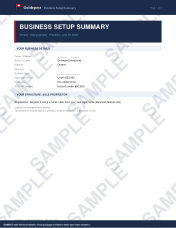
Business Setup Package$14
- Structure comparison guide
- Registration checklist
- Tax registration steps
- First-year compliance calendar
Registration steps + compliance calendar for your province
Instant download · 30-day money-back guarantee
Built by Nathan, nine years in the Canadian Army, paperwork done the hard way first.
Informational guide only. Guidepost is not a law firm. This guide explains the typical process and is not legal advice. Requirements can change. Verify current rules with the relevant government authority or a qualified professional before you act.