Selling a Boat Privately in Canada
This page is the free guide. No sign-in. Read on.
Selling a boat in Canada? The bill of sale, the Pleasure Craft Licence transfer, Form 6 for registered vessels, and the Ontario RST rules: everything you need to sell a boat privately in Canada.
Selling in Ontario? There's a dedicated guide with the RST and ServiceOntario specifics.
Sell a boat in Ontario →Free, on this page
Bill of sale template for your province
Vehicle sale guide: everything below, plus the checklist as a PDF.
$0
- Province-specific blank bill of sale
- Transfer checklist for your province
- What to hand over on sale day
- How to remove the vehicle from your record
No account needed
Free blank bill of sale: PDF download
Pick your province and the fillable PDF downloads right away. These are blank templates, not province guides.
1
Identification Number
Open this section ↓Hull Identification Number (HIN)
12 characters: stamped on the transom (rear) of the hull, starboard side
ABC12345D101Always verify this number matches the registration document before signing a bill of sale.
2
Pleasure Craft Licence vs. Vessel Registration
These are two different systems, and mixing them up is the most common boat-selling mistake.Open this section ↓These are two different systems, and mixing them up is the most common boat-selling mistake.
Pleasure Craft Licence (PCL): a unique ID number, like a licence plate. It is NOT proof of ownership. Required if your boat has one or more motors totalling 10 hp (7.5 kW) or more and is operated in Canadian waters. Valid 5 years; $24 to issue, renew, transfer, or replace (fee indexed each April 1); apply and manage it online through Transport Canada's PCELS system. Operating an unlicensed boat that requires one can mean a $250 fine.
Vessel Registration (Canadian Register of Vessels): a title system that tracks ownership. It's optional for most pleasure craft; you only need it to name your vessel or register a marine mortgage. Registration gives you a Certificate of Registry. A registered vessel does not also carry a PCL; the two are mutually exclusive. Most private recreational boats are licensed (PCL), not registered.
Don't confuse either of these with the Pleasure Craft Operator Card (PCOC), that's your personal competency card to operate a boat, like a driver's licence. It has nothing to do with the boat's own licence or registration.
3
Selling the boat but keeping the motor (or selling a motor on its own)
The licence attaches to the vessel, not to the motor.Open this section ↓The licence attaches to the vessel, not to the motor. Transport Canada describes a Pleasure Craft Licence as a number displayed on both sides of the bow, "like a car's licence plate", used for identification and not as proof of ownership. It identifies the craft.
Engine power only decides whether the craft needs a licence at all. A pleasure craft used for recreation needs a PCL if it "has one or more engines totalling at least 10 horsepower (7.5 kW), even temporarily" and is principally operated and maintained in Canadian waters. That threshold is the eligibility trigger, not a registration of the engine itself.
Here is the part that is hard to find an answer to, and it is a plain no. Across every published PCL transaction type, applying for a new or transferred licence, getting a duplicate, and cancelling one, Transport Canada asks only for government-issued ID for all owners, proof of ownership, a photo of the pleasure craft, and ownership details covering the seller's and buyer's names and signatures, the make, model and colour of the craft, and the hull serial number where available. No field, form or process in that set asks for the engine or motor make, serial number, or horsepower.
So selling the boat and keeping the outboard, or selling an outboard on its own, is not a Transport Canada reporting event. The motor is simply property. Nothing has to be reported or transferred for the motor itself. What does still apply is the licence on the hull: if the craft changes hands, the buyer transfers the PCL.
If removing the motor drops the craft below 10 horsepower (7.5 kW), that changes whether the craft needs a licence going forward. It does not create any obligation to report the motor.
4
The best way to sell a boat in Ontario or any province, step by step
Open this section ↓For a licensed (PCL) boat, the common case:
- 1Sign a bill of sale. This is the real ownership document for a licensed boat.
- 2Seller: do not cancel the licence. The PCL number stays with the boat for its entire life; cancelling it doesn't transfer anything and just leaves the boat unlicensed.
- 3Buyer transfers the PCL within 30 days, before operating the boat: government ID for all owners, the bill of sale as proof of ownership, a current photo of the boat, and the $24 fee. Transport Canada emails a temporary 30-day licence with the same number right away.
5
What is Form 6: Bill of Sale?
Form 6 is Transport Canada's official bill-of-sale template for the Small and Large Vessel Registers.Open this section ↓Form 6 is Transport Canada's official bill-of-sale template for the Small and Large Vessel Registers. It's used to transfer a registered vessel, along with the full chain of bills of sale from the registered owner to the buyer (each copy signed by both parties, with the vessel description and date; a vessel is divided into 64 shares, so joint owners must all sign).
If your boat is only licensed (PCL), the common case, Form 6 is NOT required. A plain bill of sale is accepted; Form 6 can be used as a convenient template if you'd like one.
6
Can I sell a boat without a title?
Pleasure craft in Canada generally don't have a car-style title.Open this section ↓Pleasure craft in Canada generally don't have a car-style title. A licensed boat's PCL is not proof of ownership; the bill of sale (and the chain of ownership it represents) is.
Transport Canada accepts several forms of proof of ownership: bills of sale, wills or bequests, separation or divorce agreements, court judgments, and signed transfer agreements. If none of these exist, for example, a home-built boat, a Declaration Under Oath, sworn before a lawyer, notary, or Commissioner of Oaths, can establish ownership instead. Transport Canada provides a sample declaration form on its proof-of-ownership page.
Only registered vessels have a formal title: the Certificate of Registry.
7
What the bill of sale must include
Open this section ↓- •Seller's name, address, and signature
- •Buyer's name and signature
- •Description: make, model, year, colour, length
- •The HIN (Hull Identification Number): the boat's VIN equivalent
- •The PCL number, if the boat is licensed
- •Purchase price and date
8
Selling a boat and trailer in Ontario or any province
Selling a boat on a trailer is two separate transactions.Open this section ↓Selling a boat on a trailer is two separate transactions. The trailer is a provincially registered vehicle, not part of Transport Canada's boat paperwork.
- •The boat: bill of sale + PCL transfer through Transport Canada (see above).
- •The trailer: a separate bill of sale + provincial registration/permit transfer (e.g., at ServiceOntario); the exact steps vary by province.
9
Sales tax on a private boat sale
A private seller who isn't a GST/HST registrant doesn't charge GST/HST on the sale, but the buyer may owe a provincial tax, and this varies by province.Open this section ↓A private seller who isn't a GST/HST registrant doesn't charge GST/HST on the sale, but the buyer may owe a provincial tax, and this varies by province.
- •Ontario (confirmed): the buyer pays 13% RST on a privately purchased boat and trailer (treated as "specified vehicles"), calculated on the purchase price or fair market value. Boats aren't registered at ServiceOntario, so RST is paid directly at a ServiceOntario Centre or to the Ministry of Finance along with the bill of sale, and Ontario cross-checks Transport Canada records to confirm RST was paid. Family-gift and estate exemptions exist.
- •British Columbia: PST applies to boats too (7% or 12%, depending on how the boat was acquired, per Bulletin PST 108); check the bulletin for your situation rather than assuming a single rate.
- •Other provinces: a provincial tax may apply; check with your province.
10
British Columbia: PST on a private boat sale
British Columbia taxes a boat differently depending on who sells it, and unlike a vehicle there is no registration counter where the tax gets collected.Open this section ↓British Columbia taxes a boat differently depending on who sells it, and unlike a vehicle there is no registration counter where the tax gets collected. That second part is what catches people out.
- •Private sale in B.C.: the buyer pays PST at the rate of 12% on the purchase price of the boat, including accessories, unless a specific exemption applies.
- •From a GST registrant (a dealer): 7%.
- •Bought privately outside B.C. and brought in: 12% on the depreciated purchase price.
- •Received as a gift: 12% on the fair market value.
- •Nobody collects it at a counter, so the buyer self-assesses: file a Casual Remittance Return (FIN 405) on or before the last day of the month following the month of purchase. A buyer who already has a PST number reports it on their next return instead.
Boat and trailer are taxed through two different mechanisms in B.C. The PST on the boat is self-assessed by the buyer on a Casual Remittance Return. The PST on the trailer is collected by ICBC when the trailer is registered, because trailers are subject to the PST rates for vehicles.
11
Selling to a buyer in the United States
The seller-side admin is short, and most of it is the same as any other sale.Open this section ↓The seller-side admin is short, and most of it is the same as any other sale. What changes is the licence or registration record, and the two systems behave differently.
Licensed pleasure craft (the common case): the rule does not change because the buyer lives elsewhere. If you sell your pleasure craft, do not cancel the licence. A Pleasure Craft Licence number stays with a pleasure craft for its entire life. The buyer transfers the licence into their name before operating the craft, within 30 days of the ownership change, and Transport Canada accepts government issued ID from their own country if they are a resident of another country.
One published rule does bear on the situation: a pleasure craft cannot be licensed or registered in multiple countries at the same time. Transport Canada handles cancellation as a written request giving the name, address, licence number and the reason.
- •Registered vessels are a different system: Canada does not register vessels to foreign citizens.
- •Closing a registration lists "vessel sold to a foreign citizen" as a reason. The request goes to the Vessel Registration Office with the official number, proof of ownership and the reason.
- •A deletion certificate is often issued when a vessel is sold to a foreign buyer who wants to register it in their own country. The foreign registry will need proof that the Canadian registration of the vessel has been closed.
- •On the large register, the vessel must be mortgage-free, and if the vessel has been sold the request to close must come from the new owner.
This covers the Canadian paperwork only. What the country the buyer lives in requires on arrival is their side of the transaction and is not covered here.
12
Selling the trailer too, or selling in B.C.
The trailer is a separate provincially registered vehicle with its own paperwork, and British Columbia taxes the boat itself through a route no other province uses.Open this section ↓The trailer is a separate provincially registered vehicle with its own paperwork, and British Columbia taxes the boat itself through a route no other province uses.
13
Province-specific transfer guides
One province has a dedicated boat guide so far.Open this section ↓One province has a dedicated boat guide so far. It covers the RST and ServiceOntario specifics on top of the steps above.
No dedicated boat guide yet for Alberta, British Columbia, Manitoba, Saskatchewan, Nova Scotia, New Brunswick, Prince Edward Island, Newfoundland & Labrador, Quebec. This page is the one to use.
14
Seller disclosures
Open this section ↓- •Hull condition and any damage
- •Engine hours and service history
- •Trailer included or not
- •Safety equipment included
- •Outstanding vessel loan
15
Buyer's checklist
Open this section ↓- ✓Verify HIN on transom matches all documents
- ✓For a registered vessel, check for liens via Transport Canada's Vessel Registration Query System or order a Transcript of Registry from the Canadian Register of Vessels
- ✓Check that vessel is properly licensed/registered for horsepower
- ✓Arrange marine insurance before first use
16
Frequently asked questions
Do I need a Transport Canada bill of sale to sell my boat?Open this section ↓Do I need a Transport Canada bill of sale to sell my boat?
Not a specific Transport Canada form; for a licensed (PCL) boat, any signed bill of sale works. Only a registered vessel requires the official Form 6 bill of sale, filed with the Vessel Registration Office along with the full chain of bills of sale.
What is Form 6?
Form 6 is Transport Canada's official bill-of-sale template used to transfer a registered vessel. It is not required for a licensed (PCL-only) boat, which is the common case; a plain bill of sale is accepted there.
Can I sell a boat without a title?
Pleasure craft generally don't have a car-style title. The bill of sale is the proof of ownership for a licensed boat. Only registered vessels have a formal title, called the Certificate of Registry.
How do I transfer the Pleasure Craft Licence?
The seller does not cancel the licence; the PCL number stays with the boat. The buyer applies to transfer it within 30 days of purchase, before operating the boat, using government ID, the bill of sale, a current photo of the boat, and a $24 fee through Transport Canada's online PCELS system. Online applicants get an emailed temporary 30-day licence right away.
Do I have to report selling the motor separately from the boat?
No. The Pleasure Craft Licence attaches to the vessel, not the motor. Engine power only decides whether the craft needs a licence at all, at one or more engines totalling at least 10 horsepower (7.5 kW). Across every published PCL transaction, new or transferred licence, duplicate, and cancellation, Transport Canada asks for ID, proof of ownership, a photo of the craft, and the craft's make, model, colour and hull serial number. Nothing asks for the engine make, serial number or horsepower. Selling the boat and keeping the outboard, or selling an outboard on its own, triggers no reporting or transfer obligation. If the craft itself changes hands, the buyer still transfers the licence within 30 days.
Do I pay tax when I sell a boat privately in Ontario?
The buyer does. Ontario charges 13% RST on a privately purchased boat and trailer, based on the purchase price or fair market value, paid at a ServiceOntario Centre or to the Ministry of Finance. Ontario cross-checks Transport Canada records to confirm it was paid.
How do I sell a boat and trailer together?
Treat it as two transactions: the boat (bill of sale + PCL transfer through Transport Canada) and the trailer (a separate bill of sale + provincial registration transfer, which varies by province).
Can I sell my Canadian boat to a buyer in the United States?
For a licensed pleasure craft, the seller-side rule does not change because the buyer lives elsewhere: do not cancel the licence, because a Pleasure Craft Licence number stays with a pleasure craft for its entire life. The buyer transfers it into their name within 30 days of the ownership change, and Transport Canada accepts government issued ID from their own country if they are a resident of another country. One published rule does bear on the situation: a pleasure craft cannot be licensed or registered in multiple countries at the same time. Registered vessels are a separate system, because Canada does not register vessels to foreign citizens, and a deletion certificate is often issued when a vessel is sold to a foreign buyer who wants to register it in their own country. The section "Selling to a buyer in the United States" on this page has the full detail.
What is the best way to sell a boat in Ontario?
There is one standard process, and the boat paperwork is federal: Transport Canada's, not ServiceOntario's. Sign a bill of sale; that is the real ownership document for a licensed boat. The seller does not cancel the licence, because the PCL number stays with the boat for its entire life. The buyer transfers the PCL within 30 days, before operating the boat, and in Ontario also pays 13% RST on a privately purchased boat and trailer at a ServiceOntario Centre or to the Ministry of Finance. The dedicated Ontario guide has the RST and ServiceOntario specifics.
How do I sell a boat and trailer in Ontario?
As two separate transactions. The boat: bill of sale + PCL transfer through Transport Canada. The trailer: a separate bill of sale + registration/permit transfer at ServiceOntario, because the trailer is a provincially registered vehicle, not part of Transport Canada's boat paperwork. Ontario charges 13% RST on a privately purchased boat and trailer, based on the purchase price or fair market value, paid at a ServiceOntario Centre or to the Ministry of Finance.
Done for you
Vehicle Transfer and Lien Check Package$12
- Everything in free
- Province-specific bill of sale
- Transfer checklist
- Lien search guide
Province-correct bill of sale · disclosures covered
Answer plain-language questions: we fill everything in and check each detail as you go.
Helps avoid an incomplete or rejected transfer
- Preview
- Pay
- Download instantly

30-day money-back guarantee · No account needed
Instant download · 30-day money-back guarantee
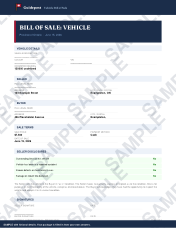
Built by Nathan, nine years in the Canadian Army, paperwork done the hard way first.
Official sources
- Transport Canada: Apply/manage a Pleasure Craft Licence →
- Transport Canada: PCL fees and service standards →
- Transport Canada: How to apply for/transfer a PCL →
- Transport Canada: Proof of ownership for a pleasure craft →
- Transport Canada: Vessel registration →
- Transport Canada: Vessel registration forms (Form 6) →
- Ontario: Retail Sales Tax on specified vehicles (boats) →
- British Columbia: PST Bulletin 108: Boats →
- British Columbia: Casual Remittance Return (FIN 405) →
- Transport Canada: closing a vessel registration →
Facts checked September 2026
Guidepost is not a law firm. This is general information, not legal advice. Full disclaimer.