Federal Benefits
Disability Tax Credit (DTC)
This page is the free guide. No sign-in. Read on.
Been told you (or your child) may qualify for the DTC? Start here.
The DTC is a non-refundable tax credit that reduces income tax for Canadians with severe and prolonged physical or mental impairments. It can also unlock the Child Disability Benefit and the RDSP.
Free, on this page
DTC eligibility checklist
Government of Canada criteria
$0
- CRA eligibility criteria summary
- What your medical practitioner needs to certify
- What to gather before your doctor's appointment
- Common reasons CRA requests more information
Free. General information only, not legal or regulatory advice.
Keep it with the rest. This one files behind tab 4 of the Home File.
No account needed
Not tax or legal advice
This guide is for general information only. Consult a tax professional or contact CRA directly for advice specific to your situation.
The official application is CRA Form T2201, which your medical practitioner must certify (Part B). It is free from the CRA: download the T2201 at canada.ca →. Guidepost does not provide the form itself; our package below is the guide, eligibility checklist, practitioner letter, and CRA cover letter that help you complete and submit it.
1
What is the DTC worth?
Open this section ↓For 2025, the federal DTC amount is $10,138. At the 14.5% lowest federal rate for the 2025 tax year (the rate fell from 15% to 14% on July 1, 2025), this is worth up to about $1,470 in federal tax savings per year ($10,138 x 14.5%). For eligible persons under 18, a supplement of up to $5,914 (2025) may apply. Provinces have their own DTC amounts on top of the federal credit.
↑ Close this section$10,138
Federal DTC Amount
2025 tax year (indexed annually, verify current amount at canada.ca/taxes for the tax year you are filing)
~$1,470/yr
Max Federal Saving
2025 tax year, at the 14.5% lowest federal rate ($10,138 x 14.5%)
Up to 10 years
Retroactive Claims
if newly approved
2
Eligibility: qualifying impairments
Open this section ↓The impairment must be severe (markedly restrict the activity) and prolonged (has lasted or is expected to last 12+ consecutive months).
Vision
Visual acuity of 20/200 or less in the better eye, or visual field of 20 degrees or less.
Speaking
Unable to speak in a way that is understood by others, or takes 3x the time of someone without the impairment.
Hearing
Unable to hear spoken words in a quiet setting, or takes 3x the time.
Walking
Unable to walk without using aids, or takes 3x the time, even with aids.
Eliminating (Bladder/Bowel)
Takes 3x the time of someone without the impairment, or requires assistance.
Feeding
Unable to feed oneself, or takes 3x the time, not including time to prepare meals.
Dressing
Unable to dress oneself, or takes 3x the time, including putting on/taking off prostheses.
Mental Functions
Marked restriction in attention, concentration, memory, judgement, perception of reality, problem solving, goal setting, regulation of behaviour and emotions, or verbal and non-verbal comprehension.
CRA applies a high bar: a diagnosis of depression, anxiety, or ADHD alone does not automatically qualify. CRA requires a 'marked restriction' present 90%+ of the time. Document specific functional limitations, not just the diagnosis.
Life-Sustaining Therapy
Requires therapy at least 2 times per week, averaging 14+ hours/week, to sustain a vital function (e.g. dialysis, Type 1 diabetes requiring multiple daily insulin injections or insulin pump therapy). Note: Type 2 diabetes managed with oral medications or insulin alone typically does not qualify under this category, consult a tax professional.
CGM/automated insulin delivery users: CRA guidance (Income Tax Folio S1-F1-C3) indicates automated systems may reduce manual therapy time below the 14-hour/week threshold. Document all insulin management time carefully and consult a tax professional before submitting.
Cumulative Effect
Significant restriction in 2 or more of the above functions (each restriction doesn't have to be severe alone).
CPP Disability is a different test from the Disability Tax Credit: it is applied for through Service Canada on form ISP-1151 with the ISP-2519 medical report, and it has its own contribution test (4 of the last 6 years, or 25 years including 3 of the last 6). The CPP Disability guide: forms, deadlines and the appeal clock →
↑ Close this section3
How to apply: step by step
Open this section ↓- 1
Check eligibility
Review the CRA's list of qualifying conditions. A medical practitioner must certify your impairment.
- 2
Get T2201 form
Download from CRA's website or use our package generator. Part A is completed by you; Part B by your medical practitioner.
- 3
Medical practitioner completes Part B
This can be a doctor, nurse practitioner, optometrist, audiologist, occupational therapist, physiotherapist, psychologist, or speech-language pathologist, depending on the impairment type. The practitioner may charge a fee for completing Part B; that fee is claimable as a medical expense on line 33099 (yourself) or 33199 (other dependants) of your tax return.
- 4
Submit to CRA
Use the CRA's digital DTC application or mail the form to your tax centre. Since July 14, 2026, the "Submit documents" feature in CRA accounts can no longer be used for the T2201. Do not include it with your tax return: T2201 is submitted separately.
- 5
CRA reviews and certifies
CRA's current target is up to 8 weeks to process a T2201 (its processing-times tool, checked September 2026); applications that need more information from the medical practitioner take longer. If approved, CRA notifies you and your tax account is updated automatically.
Check CRA processing times - 6
Claim on your tax return
Once approved, claim the DTC on line 31600 (for yourself) or line 31800 (transferred from a dependant).
Want the form itself explained, who can certify Part B, digital vs paper, and the version rule? Form T2201, explained.
↑ Close this section- 1
4
Related benefits unlocked by DTC approval
Open this section ↓Child Disability Benefit (CDB)
Up to $3,480/year ($290/month) for the July 2026-June 2027 benefit year for families caring for a child under 18 with an approved DTC. Paid as part of the Canada Child Benefit.
Registered Disability Savings Plan (RDSP)
Long-term savings plan with government matching grants (CDSG up to $3,500/year) and bonds (CDSB up to $1,000/year) for low-to-moderate income earners.
Working Income Tax Benefit (Canada Workers Benefit)
A supplementary disability supplement is available for eligible DTC holders who have earned income.
Provincial Credits
Most provinces have their own disability tax credits that stack on top of the federal amount. Amounts vary by province.
5
Retroactive claims
If you have a disability that qualified in prior years but you never applied, CRA allows you to request adjustments for up to 10 prior tax years once approved.Open this section ↓↑ Close this sectionIf you have a disability that qualified in prior years but you never applied, CRA allows you to request adjustments for up to 10 prior tax years once approved. This can result in significant refunds. Ask CRA or your tax preparer about filing T1-ADJ (T1 Adjustment Request) for each affected year, or use “Change my return” in CRA My Account.
Form T1-ADJ: canada.ca →6
Re-certification and expiry
DTC approval is not always permanent.Open this section ↓↑ Close this sectionDTC approval is not always permanent. Your Notice of Determination states the years for which the credit is approved and CRA will notify you before expiry via your Notice of Assessment.
Important: If your Notice of Determination shows no expiry date, do not reapply: your approval continues indefinitely unless CRA contacts you. You do not reapply every year.
CRA: understanding your DTC decision →
Done for you
Disability Tax Credit Package$24
- Everything in free
- T2201 application guide
- Eligibility checklist
- Practitioner preparation letter
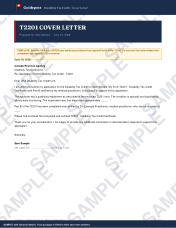
- CRA cover letter template
T2201 guide + practitioner preparation letter
Answer plain-language questions: we fill everything in and check each detail as you go.
Helps reduce back-and-forth with CRA and your practitioner
- Preview
- Pay
- Download instantly





30-day money-back guarantee · No account needed
Instant download · 30-day money-back guarantee
Built by Nathan, nine years in the Canadian Army, paperwork done the hard way first.
Related guides
Facts checked September 2026 · Sources: CRA T2201 Guide (canada.ca/disability-tax-credit), Income Tax Folio S1-F1-C3, Canada Child Benefit (canada.ca).